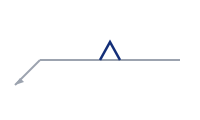
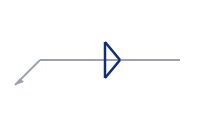
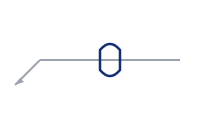
Double-V butt weld
Applied to joint
Butt joint — plates aligned end to end
Download
Shop
Equipment for groove welds
MIG and TIG machines suited for groove weld preparations on plate.
→ weldingandwelder.com
Description
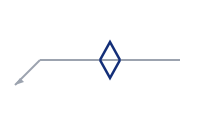
A butt weld prepared from both sides, forming an X-shaped groove. Welded from both sides, usually with backgouging of the first side before welding the second. Significantly reduces distortion and weld metal volume compared to a single-V on thick plate.
In plain English
Both plates get bevelled on both sides, giving you an X-shaped groove. You weld one side, then flip it (or gouge out the root from the other side) and weld that too. Uses roughly half the filler of a single-V because the groove is split between two sides. Much less distortion because the shrinkage forces balance out. The go-to prep for plate over 20 mm when you have access to both sides. The two V-grooves do not have to be symmetrical -- often the first side is deeper (about 2/3) so the backgouge side is quicker.
Symbol position
X symbol (V symbols on both sides of the reference line).
Size notation
Groove angle, root opening, and root face for each side. Depths may differ (asymmetric double-V).
Notation examples
Same groove angle notation differences as single-V, applied to both sides.
Each side dimensioned independently. CJP (complete joint penetration) assumed unless noted.
Both sides dimensioned. Asymmetric preparations common -- depths specified with 's' for each side.
Common uses
- Thick plate butt joints (>20 mm) with both-side access
- Ship hull plating
- Bridge girder flanges
- Pressure vessel shells where distortion control is critical