Fillet weld
Applied to joint
T-joint — fillet welds both sides
Download
Shop
Wire for fillet welds
ER70S-6 and flux-cored options commonly used for structural T-joints.
→ weldingandwelder.com
Description
A triangular cross-section weld joining two surfaces meeting at an angle, typically 90 degrees. The single most common weld type in structural fabrication, accounting for approximately 80% of all welds. The critical sizing difference between ISO and AWS standards makes this the most important symbol to understand correctly.
In plain English
The workhorse of welding. A fillet is the triangular weld you lay into the corner where two plates meet at right angles -- like caulking a bathtub, but with molten metal. The symbol is a right triangle on the reference line. HERE IS THE BIG ONE: ISO and AWS size fillets differently. In AWS, the number next to the symbol is the LEG length. In ISO, you MUST use a prefix: 'a' means throat thickness, 'z' means leg length. If you see '6' on an AWS drawing, that is a 6 mm leg. If you see 'a4' on an ISO drawing, that is a 4 mm throat (which gives you roughly a 5.6 mm leg on an equal-leg fillet). Getting this wrong means your weld is the wrong size. This is probably the single biggest source of cross-standard errors on shop floors.
Symbol position
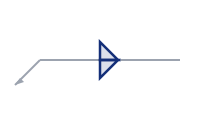
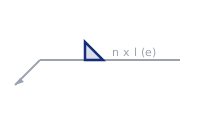
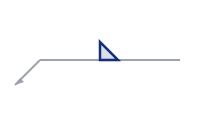
Right triangle on the reference line. Arrow side below the line, other side above (AWS/ISO System B). In ISO System A, arrow side on the solid line, other side on the dashed line.
Size notation
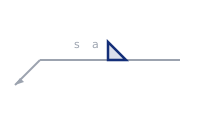
AWS: leg size as a number to the left of the symbol. ISO: 'a' prefix = throat thickness, 'z' prefix = leg length. Length of weld to the right.
Notation examples
THIS IS THE BIGGEST STANDARDS DIFFERENCE. AWS sizes fillets by leg length (no prefix). ISO requires 'a' (throat) or 'z' (leg) prefix. An ISO 'a5' fillet and an AWS '5' fillet are DIFFERENT SIZES. Fabricators working across standards must understand this or welds will be incorrectly sized. An 'a5' throat on a 90-degree equal-leg fillet gives ~7.07 mm legs. A '5' AWS fillet gives 5 mm legs with ~3.54 mm throat.
Size is ALWAYS leg length. No prefix used. A single number to the left means leg size in that unit. For unequal legs, both dimensions given.
MUST use 'a' (design throat thickness) or 'z' (leg length) prefix. 'a' is more common in design because throat is the structural dimension. Deep penetration throat uses 's' prefix.
Common uses
- T-joints (web to flange, stiffeners to plate)
- Lap joints
- Corner joints (external fillet)
- Virtually all structural steel connections
- Pipe-to-flange and nozzle-to-shell joints