Intermittent fillet weld
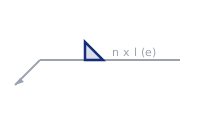
Applied to joint
T-joint — fillet welds both sides
Download
Shop
Wire for fillet welds
ER70S-6 and flux-cored options commonly used for structural T-joints.
→ weldingandwelder.com
Description
Fillet welds placed at regular intervals along a joint rather than continuously. Reduces welding time, distortion, and cost where full continuous welding is not structurally required. Notation specifies number of welds, length of each weld, and pitch (spacing).
In plain English
Instead of running one long continuous fillet, you weld short sections with gaps between them. Saves time and reduces heat distortion. The notation tells you: how long each weld section is and what the pitch (centre-to-centre spacing) is. For example, '50 (100)' means 50 mm long welds at 100 mm pitch. Be careful -- ISO measures pitch centre-to-centre, and so does AWS, but older drawings might show gap distance instead of pitch. Always check.
Symbol position
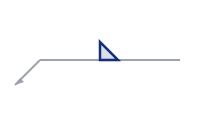
Fillet triangle on the reference line with length and pitch notation.
Size notation
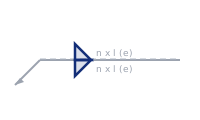
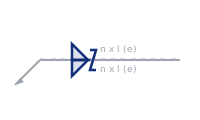
AWS: size to left, then length-pitch (e.g., 5/50-100 means 5 mm leg, 50 mm long, 100 mm pitch). ISO: size, then n x l (e) for count x length (pitch).
Notation examples
Notation format differs. AWS uses length-pitch (e.g., 2-4), ISO uses n x l (e). Both measure pitch centre-to-centre, but the way it is written on the symbol looks different. Ensure your welders know which standard the drawing uses.
Length and pitch separated by a dash. Pitch is centre-to-centre.
n x l (e) format: n = number of weld elements, l = length, e = pitch (centre-to-centre).
Common uses
- Stiffener-to-plate connections (where continuous weld is unnecessary)
- Built-up beams and plate girders
- Tank and silo shell-to-roof connections
- Lightweight structural frames