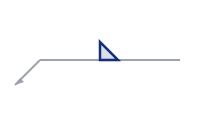
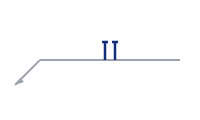
Stake weld
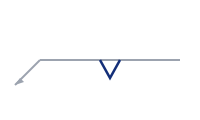
Applied to joint
Surface build-up / overlay on base plate
Download
Shop
TIG welders for edge welds
Precision TIG machines for thin sheet and edge weld applications.
→ weldingandwelder.com
Description
A T-joint weld made by a high-energy beam (laser or electron beam) from the horizontal member through to the vertical member below. The beam penetrates through the top plate and fuses into the vertical plate underneath without any visible preparation on the top surface.
In plain English
A laser or electron beam fires down through the flat plate and fuses into the upright plate underneath, making a T-joint without any prep or access to the joint line itself. From the top, you might not even see the weld -- just a narrow line where the beam passed through. This is a specialised process for automated manufacturing where you need clean, narrow T-joints without fillet welds on the surface. Common in automotive and aerospace where surface finish matters.
Symbol position
Inverted triangle (V below reference line) on the reference line.
Size notation
Penetration depth specified. Beam width may be noted.
Notation examples
Stake weld is an ISO-specific symbol. AWS does not have a direct equivalent and would rely on process notes, supplementary symbols, or detail drawings to convey the same joint.
Not a standard AWS symbol. Would typically be covered by process-specific notation.
ISO 2553 includes the stake weld symbol (inverted triangle). Penetration depth dimensioned.
Common uses
- Laser beam T-joints in automotive body-in-white
- Electron beam T-joints in aerospace
- Automated panel stiffener attachment
- Applications requiring minimal surface disturbance