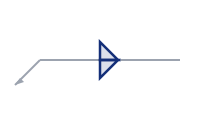
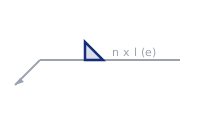
Staggered intermittent fillet weld
Applied to joint
T-joint — fillet welds both sides
Download
Shop
Wire for fillet welds
ER70S-6 and flux-cored options commonly used for structural T-joints.
→ weldingandwelder.com
Description
Intermittent fillet welds on both sides of a joint with the weld elements offset (staggered) so that the welds on one side fall in the gaps of the other side. Sometimes called a Z-pattern. Provides more even load distribution than chain intermittent.
In plain English
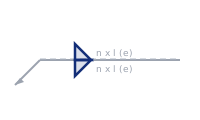
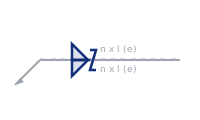
Intermittent fillets on both sides, but offset so where there is a weld on the top, there is a gap on the bottom, and vice versa. Like a zigzag or Z-pattern. This gives more even heat distribution along the joint and can be structurally superior to chain intermittent because there is always a weld somewhere along the joint. The symbol uses a Z-shaped arrangement across the reference line.
Symbol position
Fillet symbols on both sides of the reference line, offset (staggered). Z-symbol indicator may be used.
Size notation
Same conventions as intermittent fillet, offset on each side.
Notation examples
Same notation format differences as intermittent fillet. Both standards show the stagger by offsetting symbols on opposite sides of the reference line.
Staggered pattern indicated by offsetting the weld symbols on opposite sides of the reference line.
Z arrangement shown. Stagger indicated by offset symbols on both sides of the reference line.
Common uses
- Web-to-flange joints requiring even load distribution
- Long seams where heat build-up must be minimised
- Lightweight plate girder fabrication
- Connections where continuous welding would cause excessive distortion